
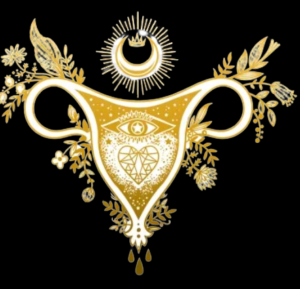
Womb healing is the healing of our sacred womb, the place of creation and transformation in our lives.
The womb chakra also known as The sacral chakra is the second chakra in the Hindi tradition, and also known as the Svadhisthanachakra. It is an energy center related to pleasure, creativity, joy, and passion.
The womb is a sacred and powerful place in a female body. It’s the source of potential life and also a place that, for many women, monthly sheds its lining, creating anything from mild discomfort to excruciating pain. It’s a place where conditions like endometriosis or polycystic ovarian syndrome can wreak havoc on our body systems. It can grow from the size of a pear to a watermelon in pregnancy, and then it can return right back to its original size. It can be a place of miscarriage, abortion, child loss, or child birth. The womb chakra can also be a place where we store our trauma. The womb is the centre of both death and life.
I thought about mine the most, perhaps, when I was newly pregnant after having had a miscarriage. I had a hard time understanding that this was a place of both nourishment and growth for a new baby when it had felt like a graveyard just a few short months ago. I sat with it, meditated with it, placed my hands over my belly and tried to feel and breathe and understand this part of me. It felt very strange to be creating life in a place that had so recently brought me death and devastation.
Though we do not see them together very often in our culture, death and life constantly feed into each other in the natural world. Wild animals must kill in order to find life-giving nourishment.
In the Hindu worldview, death and life are constantly intersecting cycles: One cannot exist without the other. The three main godheads are Brahma the Creator, Vishnu the Sustainer, and Shiva the Destroyer.
In one famous story, Shiva’s great love has died, and he carries her body across the skies, grieving desperately, his wails threatening to throw the universe out of balance. In order to restore that balance, Vishnu uses a special weapon to cut Shiva’s wife’s body into pieces, allowing them to fall on different sacred places across India. Instead of snapping back to work (and who would, after an experience like that?) Shiva retreats to his meditation cave and refuses to come out. That means he isn’t doing the vital work of destroying things so that new things can be born. This allows new demons to come to power in the world of the Gods, and Shiva must be coaxed out of his meditation and into relationship with the world again so that he can continue to cause appropriate endings so that beginnings can be possible.
Menstruation is a sort of monthly death: The lining of the uterus grows to support a baby if one should be conceived, and when one is not, the lining is shed, released to create the possibility of a new cycle beginning again. This is a good thing—some people believe this monthly shedding is an important way for women to detoxify their systems. This might be one reason women tend to live longer—we have an extra way of releasing toxins from the body that people who don’t menstruate do not have.
Energetically, our wombs can also help us shed the toxins of our lives once a month (or however frequently we menstruate). Many times after a painful experience in my life, I have waited for the blood to come to help release the experience from my body. Our wombs gather our experiences over the course of a cycle and then go through a sacred process of releasing those experiences, of letting go.
From the Hindu Shakta Tantric perspective, femininity is the domain of the goddess—the domain of power. It contains multitudes. In Tantric mythology, the goddess is beautiful, sweet, and fertile—she is the one who is needed to coax Shiva out of his grief meditation, to call him into the pleasures of sex and relationship so he can return to his work as the god of destruction. She is fertile, the mother of everything. But she is also a warrior, like Kali, the dark goddess who thrives on the battlefield, fighting for justice and thirstily licking up the drops of blood shed by her enemies. The goddess is fierce, and can change her face from saumya, or beautiful and sweet, to ghori, or horrifying, depending on what she needs in the moment. She is pure creative energy, the energy of everything.
So how do we understand our wombs, these small dark places that can hold so much mythology, so much potential, and also so much pain?
There is a great value to sitting with our wombs, listening to them, talking to them, and allowing them to teach us something about the way life and death, joy and pain, can exist together inside this sacred centre, whether there is a literal womb there or not.
Meditating with this part of the body, even writing a letter to it, can be a deeply healing act that can help us to integrate our multitudes and find power in our feminine selves, even and especially when those feminine selves feel fraught or difficult to understand.
One way to practice womb healing is by honouring the sacred cycles of menstruation. Notice how your mood and energy shift around your period. Rather than trying to push through these energetic phases, try honouring them instead. When you are bleeding, you are in a death-state: a moment of mourning the potential of life while also cleansing the experiences of your last cycle.
Rest more during this time and pay extra attention to your emotions. You do need to eat more while your body is going through this hard work of cleansing, so eat nourishing foods and drink lots of clean water that will help you with that cleansing.
While you are regrowing the lining of your uterus and ovulating, you may notice that you are more social, have more energy, are more interested in starting new projects—go for it. Use this energy to boost your work and life plans.
In the few days leading up to your period, your focus needs to turn inward again, and you may find that it’s a time when you want to organise, clean, tie up loose ends before the release of your period. Honour that. Let the natural cycles of your body work for you as you get to know your womb and the wisdom it has for you.
If you do not menstruate, you can still follow this practice by following the moon. The new moon would be the menstruation time and the full moon represents ovulation. Observe your mood and energy as you move through the moon cycles. Do a cleansing practice of some kind on the new moon, such as taking a mindful bath or burning some cleansing sage.
However you understand it, your womb is a powerful place for feminine energy—the energy of power, creativity, death, and life.
As an energy healer I offer workshops on womb healing. Contact at https://lifecoachruchihkaalraa.com/to know more .